
24-Week Continuing Care Assistant Programs: Start Your Healthcare Career Quickly
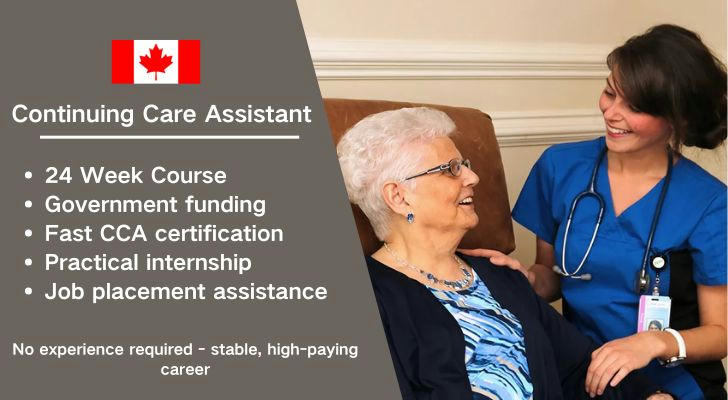
Government Funded | 24 Week Fast Certification | No experience needed | Job Placement
To meet the growing demand for personal care workers across Canada, government-funded Continuing Care Assistant (CCA) programs provide a fast and practical pathway into the healthcare sector. This 24-week program combines classroom-based theory with hands-on practical training, leading to a recognized CCA diploma along with several essential industry certificates. With employment support, learners are well prepared to enter a meaningful and opportunity-rich healthcare career.
⭐ Why Choose a Government-Funded Continuing Care Assistant Program?
- Government Support: This project is funded by the Government of Nova Scotia. Other eligible assistance programs may include help with transportation costs, childcare, and living allowances, depending on individual eligibility.
- Recognized Credentials: Graduates receive an official Continuing Care Assistant diploma, along with multiple workplace-ready certificates recognized by healthcare employers.
- No Prior Experience Required: This program is designed for beginners and career changers. Previous healthcare or caregiving experience is not required.
- Short-Term, Career-Focused Training: The program is completed in 24 weeks, combining theory with practice, including a comprehensive 204-hour supervised practicum.
- Employment Placement Support: Job placement assistance and ongoing career development services help graduates transition smoothly into the workforce.
📘 What Will Be Learned?
Participants gain both technical skills and professional competencies, including:
- Foundations of healthcare and the CCA role
- Personal care assistance (mobility, hygiene, nutrition, daily living support)
- Effective communication and patient-centered care
- Infection control, workplace safety, and WHMIS
- Dementia and Alzheimer’s care principles
- Collaboration within interdisciplinary healthcare teams
- Supervised clinical practicum experience
🏫 Government-Funded Training Providers in Nova Scotia
🏥 These programs are recognized by the Nova Scotia Health Association (HANS) and guided by the Department of Seniors and Long-Term Care (DSLTC).
Approved institutions include:
- Cape Breton Business College (CBBC)
- Eastern College
- Nova Scotia Community College (NSCC)
- Northwood Career College
- Université Sainte-Anne
👥 Who Can Benefit from This Program?
| Age Group | How the Program Helps |
|---|---|
| 18–25 | Fast entry into healthcare with no prior experience |
| 26–35 | Career transition into a stable, in-demand field |
| 36–45 | Practical re-skilling with strong employment prospects |
| 46–55 | Structured training to return to the workforce |
| 55+ | Meaningful second career focused on community care |
📝 How to Apply?
- Select an approved training institution
- Submit an application and meet admission requirements
- Complete eligibility screening for government funding
- Enroll, begin training, and prepare for practicum placement
This article describes the general process, which depends on the specific situation.
💼 Career Opportunities After Graduation
Graduates are qualified for roles such as:
- Continuing Care Assistant
- Care Team Assistant
- Home Support Worker
- Home Care Worker
- Personal Care Worker
Employment opportunities are available in long-term care facilities, hospitals, community organizations, and home care agencies across Canada.
🌟 Real-Life Success Story
Mary had no prior healthcare experience and was seeking a stable career with purpose. Through a government-supported CCA program, she completed her training in 24 weeks, gained hands-on practicum experience, earned her diploma, and successfully entered the long-term care workforce.
🚀 Final Thoughts
A 24-week Continuing Care Assistant program offers a practical and supported route into Canada’s healthcare sector. With government assistance, a strong balance of theory and real-world practice, and solid employment outcomes, this pathway is well suited for those seeking a meaningful healthcare career in a short time frame.